3 min read

Attackers’ Truth: Adapting the Storm-2949 Cloud Breach for Red Teaming

Attackers’ Truth: Adapting the Storm-2949 Cloud Breach for Red Teaming

In February 2026, a critical manufacturing organization was compromised not by zero-day malware, but by their own cloud architecture.

Storm-2949 proved that the most devastating breaches leverage legitimate control plane features. The threat actor bypassed initial defenses via Self-Service Password Reset (SSPR) abuse, wiped out existing MFA, and enrolled their own devices. From there, they weaponized existing Privileged Role-Based Access Control (RBAC) assignments to extract credentials from Azure Key Vaults and Storage accounts.

Because every action utilized legitimate Azure features, the attack blended perfectly with routine administrative behavior.

At Exploit Labs, our philosophy is simple: Attackers’ Truth. We do not sell automated vulnerability scans or theoretical reports. We deliver sophisticated red teaming engagements and adversary simulation. For security leaders, the Storm-2949 breach is not just a threat intelligence briefing—it is an actionable blueprint for your next automated red team scenario.

Automating the Storm-2949 Scenario

Continuous, scenario-based red teaming must ingest real-world vectors immediately. In an era where 94% of professionals recognize AI as the primary driver of change, static annual pentests are obsolete.

By taking the Storm-2949 attack path as precedence, Exploit Labs translates intelligence into automated, continuous testing within an ongoing red team program. This allows us to validate your detection engineering by orchestrating the following automated checks:

  • Identity & SSPR Abuse: Simulating MFA manipulation and the enrollment of rogue Authenticator devices.
  • Graph API Enumeration: Executing directory discovery scripts to map users and service principals, testing your threshold for API abuse alerts.
  • Control Plane Weaponization: Safely mimicking the extraction of basic authentication credentials from Azure App Service publishing profiles and Key Vault secrets.

Every test links a technical vulnerability to a concrete business risk. An Azure Key Vault compromise is not merely an IT problem; it is an enterprise existential threat that triggers regulatory fines, operational downtime, and immediate loss of board confidence.


The Storm-2949 Attack Chain

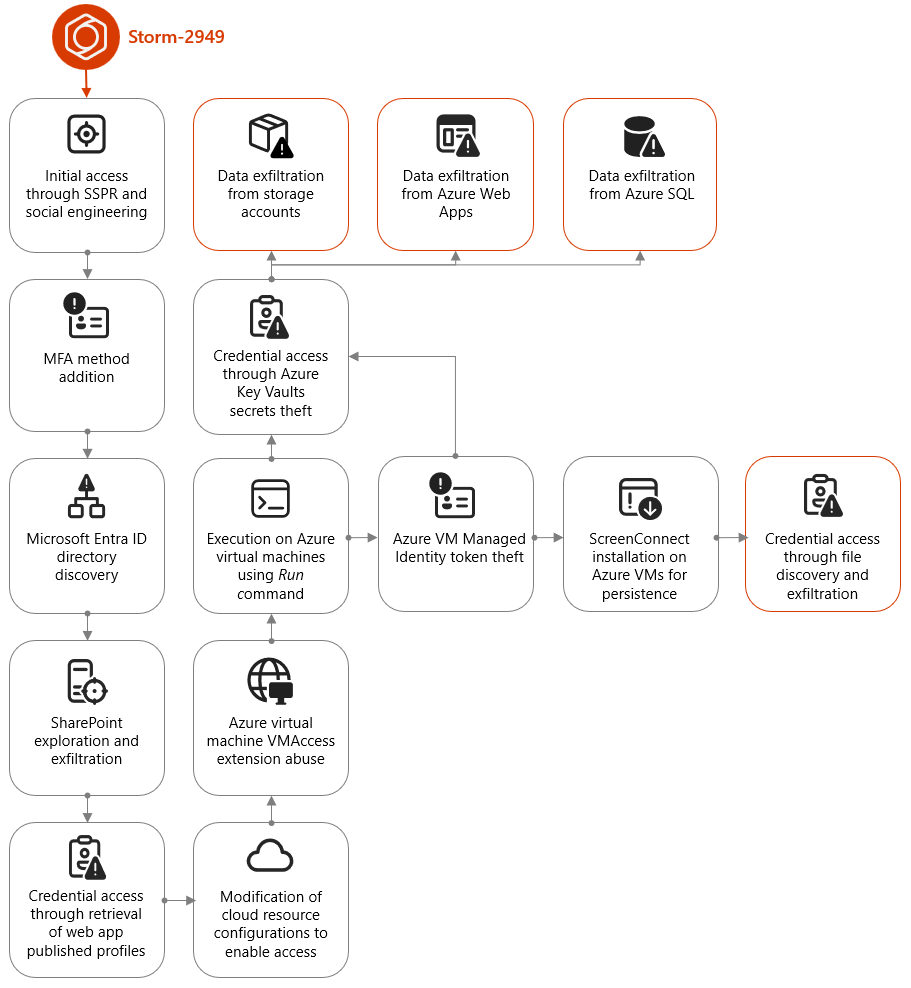
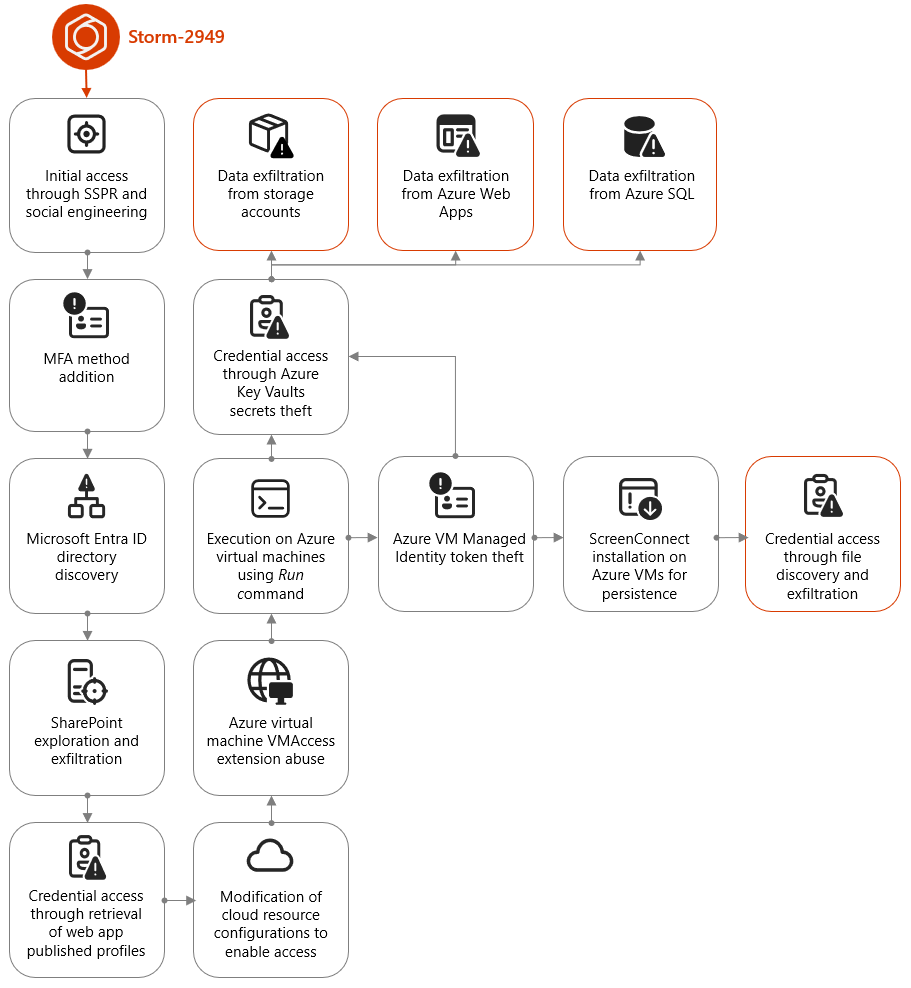
  • Initial Hijack via SSPR: The actor bypassed perimeter defenses through social engineering, abusing the Self-Service Password Reset (SSPR) process. They deleted the legitimate user's existing MFA methods and registered their own devices, establishing immediate, locked-in persistence.
  • Automated Cloud Reconnaissance: Using custom Python scripts and the Microsoft Graph API, they mapped the tenant's directory, specifically hunting for privileged users and vulnerable service principals.
  • M365 Data Theft: Downloaded thousands of sensitive IT documents, VPN configurations, and remote access procedures directly from OneDrive and SharePoint web interfaces.
  • Credential Extraction & Lateral Movement: When direct access to production web apps failed, they pivoted to auxiliary Azure App Services to extract publishing profiles. This access allowed them to breach Azure Key Vaults and strip out database connection strings and identity credentials.
  • Infrastructure Exfiltration: Manipulated network configurations and firewall rules on Azure Storage accounts and Azure SQL servers. Using the stolen credentials and the Azure Storage SDK, they silently siphoned massive volumes of blob and database data.
  • VM Subversion & Defense Evasion: Weaponized legitimate Azure VM extensions (VMAccess and Run Command) to create local backdoor accounts, blind Microsoft Defender Antivirus, clear event logs, and deploy ScreenConnect for persistent endpoint discovery.

storm-2949_red_team_attack_chain

The Complexity: Weaponizing Legitimate Architecture

This operation was a masterclass in identity-driven, "living off the cloud" methodology. The complexity lies not in custom zero-day exploits, but in the abuse of existing trust boundaries.

The threat actor operated in parallel across Microsoft 365, Azure infrastructure, and virtual machines simultaneously. Because they strictly utilized legitimate management features and existing Role-Based Access Control (RBAC) privileges, their actions were structurally indistinguishable from routine IT administration.

When network gateways blocked their initial attempts, they demonstrated extreme operational agility, pivoting to secondary resources within the ecosystem rather than deploying noisy exploits. This renders traditional, signature-based SOC monitoring entirely useless. If a security team cannot correlate a sequence of individually benign control plane operations, the business is completely exposed to silent, catastrophic data loss and subsequent regulatory penalties.

Who Needs This Level of Validation?

This automated scenario testing is not for low-maturity environments. It is engineered for organizations with 500+ employees and €50M+ in revenue, particularly those operating in high-stakes verticals.

1. DACH & Iceland (Regulatory Mastery) Theoretical compliance is dead. With mandates like DORA, TIBER-EU, and ISO 27001 aggressively enforced, organizations in finance, insurance, and banking must prove continuous operational resilience. The European enterprise sector requires precision testing that satisfies strict board-level risk reviews and external audits. If your SOC cannot detect a Storm-2949 control plane lateral movement, you will fail your DORA Threat-Led Penetration Testing (TLPT) requirements.

2. GCC & MENA (Frontier Infrastructure) Organizations in the Gulf are building the digital foundations for Vision 2030. This means massive IT/OT convergence, hybrid cloud environments, and Smart City deployments. Critical infrastructure—spanning energy, utilities, and telecom —are prime targets for advanced persistent threats (APTs) seeking to exploit complex access paths. You require a testing partner with hybrid expertise and regional compliance mastery to secure these high-value networks.

Stop Guessing. Start Proving.

We are your modern adversary. Do not wait for a regulatory audit or a past security incident to dictate your readiness.

Request a DORA Readiness Assessment or Book a Free Discovery Call today to integrate Storm-2949 scenario testing into your security pipeline.

Source: https://www.microsoft.com/en-us/security/blog/2026/05/18/storm-2949-turned-compromised-identity-into-cloud-wide-breach/ 

Cybersecurity Breakfast Session together with the Austiran Business Council, Netherlands Business Council and the German Emirati Joint Council for Industry & Commerce

Cybersecurity Breakfast Session together with the Austiran Business Council, Netherlands Business Council and the German Emirati Joint Council for Industry & Commerce

Speaking at the recent Austrian Business Council UAE cybersecurity event reinforced a critical market reality. The region is building the future, but...


Read More
One-Off vs. Managed Pentesting: What Financial Institutions Must Know

One-Off vs. Managed Pentesting: What Financial Institutions Must Know

Banks and large enterprises are not defined by a single website or mobile app. A modern financial institution might operate hundreds of...

Read More
We have security solution X, do we even need a pentest?

We have security solution X, do we even need a pentest?

"We already run Vectra and CrowdStrike — do we still need pentests?" This caught me a bit off-guard.

Read More